Mostrar mensagens com a etiqueta fanfarlo. Mostrar todas as mensagens
Mostrar mensagens com a etiqueta fanfarlo. Mostrar todas as mensagens
domingo, 1 de julho de 2012


quarta-feira, 29 de fevereiro de 2012
Fanfarlo - Rooms Filled With Light
Publicado originalmente em http://stipe07.blogs.sapo.pt/235926.html
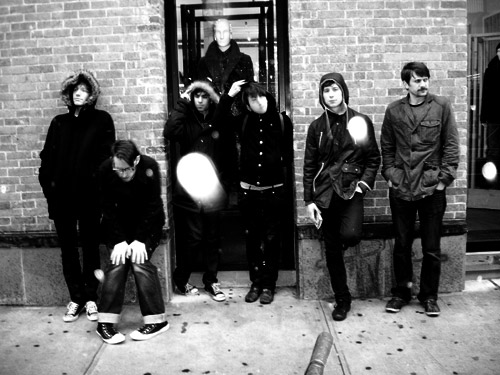
Finalmente terminou uma longa espera de três anos... Depois do bem sucedido Reservoir, o trabalho de estreia editado em 2009, chegou às lojas ontem, dia vinte e oito de fevereiro, através da Canvasback Music/Atlantic, Rooms Filed With Light, o segundo disco da banda londrina de pop folk Fanfarlo, liderada pelo carismático músico sueco Simon Balthazar.Rooms Filled With Light foi produzido por Ben Allen (Animal Collective, Deerhunter, Gnarls Barkley) e misturado por David Wrench (Bat For Lashes, Everything Everything) no Bryn Derwen Recording Studio, no País de Gales. A bela e abstrata capa é da autoria de Allison Diaz.
Algo que replico aqui algumas vezes, por ser hábito dizer-se no mundo da música, é a dita maldição do segundo álbum e que assombra quase sempre as bandas que conseguiram um suceso estrondoso na estreia, normalmente à custa da invenção de uma nova sonoridade. E os Fanfarlo têm, na minha opinião, a felicidade de terem produzido algo inovador comReservoir, encarnando nesse disco o mesmo espírito indie épico dos Arcade Fire, mas com uma sonoridade menos elétrica e mais folk. Esse disco acabou por ser um marco num ano que foi extraordinário e de definitiva afirmação para o cenário musical indie e alternativo.
Mudar essa fórmula de sucesso e que levou a banda a receber inúmeros e justos elogios da crítica, poderia ser uma jogada arriscada. No entanto, parece-me que estes ingleses Fanfarlotiveram a coragem necessária para testar uma nova estética sonora em Rooms Filled With Light, mas sem perderem demasiado a bússola que os orientou na estreia, o que me leva a questionar se a adopção de novas nuances sonoras na sonoridade dos Fanfarlo valeu o esforço, ou teria sido preferível um maior conservadorismo e produzir uma espécie deReservoir II. Singles como Deconstruction e Shiny Things, já conhecidos há várias semanas e que divulguei na altura, já apontavam para o caminho certo de consolidação da sonoridade intrínseca desta banda, feita com melodias hipnotizantes que conseguem misturar os mais inusitados instrumentos com incrível mestria, mas agora com a incorporação de alguns elementos eletrónicos, que serviram para adicionar um certo tempero, mas sem deixar de lado os belos arranjos que marcaram o disco de estreia.
Logo na abertura, com Replicate, disponível para download gratuito no sitio da banda, osFanfarlo assumem toda aquela energia contagiante e a alegria que habitualmente transmitem nas suas canções, feitas com violino, trompete e bandolim, mas agora transmitidas com mais cordas e sopros e a voz de Simon a fazer lembrar uma fusão britânica entre Win Butler e David Byrne. As músicas têm mais textura, são mais barrocas e contemplativas e sente-se mais a música clássica e o jazz e algum do eletropop dos anos oitenta. Simon escreveu grande parte das canções em Londres, mas depois foram trabalhadas pelo quinteto numa pequena casa perto do mar, com uma fabulosa paisagem a influenciar certamente o disco.
Se a primavera parece, infelizmente, ter chegado metereologicamente mais cedo, agora, numa mistura entre o épico e o contemplativo, chegou o primeiro disco do ano que nos relembra a alegria que é estar vivo para ouvir e testemunhar que os Fanfarlo dão, com esteRooms Filled With Light, mais um pequeno passo em frente no campo da excelência, onde residem desde Reservoir e com todo o mérito. Espero que aprecies a sugestão...
01. Replicate
02. Deconstruction
04. Shiny Things
05. Tunguska
06. Everything Turns
07. Tightrope
08. Feathers
09. Bones
10. Dig
11. A Flood
12. Everything Resolves
sábado, 28 de fevereiro de 2009
Fanfarlo Empties the Reservoir

When a band’s name derives from Charles Baudelaire novella that was released in 1847, I do not think that calling the members a bunch of bookworms would be an exaggeration. Many of us appreciate fine literature and its influence has fascinatingly proven to apply to more than just writers. Diction, vocabulary, and style are just a few basic things that a writer or poet can take as an influence from quality literature, but what the average reader can take away may be even more impactful. Movies can provide great visual justice as to how life looked in the 1700s, 500s, and 1 BC with costumes, set props, and overdone accents, but can any film truly exceed the historical relevance of literature that was actually written during its referenced period? It’s doubtful. Most historians would prefer studying the textual version of Beowulf to seeing the film version, for the reason that no amount of research can be as effective as practically going back in time by reading the thoughts, descriptions, and ideologies of individuals that existed at that specific time. This is the reason why Fanfarlo chose to provide an ode of sorts to Baudelaire’s La Fanfarlo, as the period piece is a summation of Fanfarlo’s appreciation for all things scenic, engrossing, and throwback.
The London-based six-piece have been through a wide array of books, with the titles ranging from Penguin’s History of the World to Kurt Vonnegut’s classics, and Fanfarlo allow their historical reverence shine through on a track like “Harold T. Wilkins” History buffs like Colin Meloy and Sufjan Stevens have fared well in the world of indie-rock, but comparing their material to Fanfarlo does not give enough individualistic justice to the six-piece. Apart from the fact that their lyrical approach is never pretentiously inclusive to listeners that wholly understand the historical context, Fanfarlo have a steady pop ideology that distances itself from other contemporaries that opt for intricacy over infectiousness. With this in mind, I guess it is no surprise that a Swede is responsible for the group’s origins. Simon Aurell formed Fanfarlo in 2006 with Justin Finch, performing as a duo until five others joined throughout the following years. It speaks enough of the Fanfarlo’s potential that the five others joined after seeing some incarnation of Farnfarlo live. After coming away so impressed, there was nothing else to do but join. Mark West left the band in December, making Fanfarlo a six-piece for the February 14th release of their debut full-length album, Reservoir. Prior to Reservoir, Fanfarlo released four singles on a four different labels. Two of the most recent, “Harold T. Wilkins” and “Fire Escape”, appear on Reservoir.

The glittery allure of “Fire Escape” has made it arguably Fanfarlo’s most recognizable song up to this point. The six-piece are likely relieved by this too, as the track summarizes their style quite well. Aurell shows off his pop songwriting chops with a majestic chorus that effervescently erupts with horns, bass, electric guitars, and Aurell’s balmy voice. The verses benefit from a similar degree of chamber-pop goodness, with a key-led arpeggio found focused under a thick array of electric guitar progressions and prominent bass use. When listening to this, it should make sense to listeners why Fanfarlo made “Fire Escape” the first single from Reservoir; the first several minutes are filled with purely infectious goodness, while the sweeping conclusion of trumpets and strings establish the sentiment that Fanfarlo’s vision is too ambitious to be grouped in with the other chamber-pop acts that stick together a few verses and a chorus and call it a day. This is a group that intricately crafts their songs for maximized cohesion, as the conventional structural tendencies that expose their distinctive style of pop music always has a good amount of ambitiousness at its side to make things diverse enough for everyone. Fans of chamber-pop, folk, and Brit-pop will likely be the ones most satisfied with Fanfarlo, but I would be surprised if anyone who enjoyed indie-pop could resist either “Fire Escape” or “Harold T. Wilkins”. Both are fantastic tracks that precluded the release of Reservoir very nicely.
The ode to Harold T. Wilkins, an early 20th century British journalist and historian, is more straightforward with its stylistic delivery. The folky, acoustical progression that is introduced along with Aurell’s vocals sounded immediately familiar to me, but Fanfarlo’s ability to execute melodic transitions allows the song to follow into uncharted territory once Cathy Lucas’ backing vocals are incorporated. Like “Fire Escape”, “Harold T. Wilkins” features a star-studded chorus that expresses both joy and charisma in its twinkling and melodically astute nature. As for the album’s new tracks, “I’m a Pilot” and “Ghosts” are two efforts that show an edgier side of Fanfarlo. A simplistically poppy bass line initially takes control of “Ghosts”, quickly to be accompanied by a flurry of strings that seem to act as a representation of tension and chaos. Although both of the album’s preceding singles were excellent, it would be hard to argue against “Ghosts” being one of their best written songs. A mixture of horns, keys, and guitars are used to their full potential here as the track separates between instrumental and vocal sections in increasingly effective form. The way that “Ghosts” builds up is extraordinarily and it proves highly indicative of the band’s level of talent. The opening “I’m a Pilot” is one of their more dramatic efforts, mixing somber strings with opportunistic keys over a percussive procession that steadily evolves over a repeating piano progression. Just like many other songs on the album, the conclusion is one of the finest points of the song because of the masterful way that it utilizes all previous instruments to orchestrate something moving and convincingly powerful. It is a representation of Fanfarlo’s grandiose scope, a quality that makes Reservoir one of the most memorable debuts of 2009.
available at:http://obscuresound.com/
Fanfarlo - Fire Escape
Subscrever:
Mensagens (Atom)